
Features
Every tool a completion engineer needs
Insight combines CFD-grade physics with fast, interactive workflows. Resolve device-level flow, optimise full-well completions, and export ready-to-run models for your reservoir simulator, all from one application.
Coupled reservoir-to-surface solve
Insight runs reservoir, completion, valves, and riser as one coupled system. With Auto-couple enabled, a Picard iteration synchronises inflow and outflow at every schedule period, converging on a self-consistent annulus pressure that satisfies both the depletion physics and the lift physics. Choose the analytical zonal solver for fast screening or the 3D finite-difference solver for detailed studies, both share the same rock, fluid, and completion inputs.
- -Two reservoir solvers: analytical zonal and 3D finite-difference
- -Picard-iterated coupling at every schedule period for self-consistency
- -Productivity index updates dynamically from observed drawdown
- -Stochastic permeability fields supported in the numerical solver
3D wellbore visualisation
Interactive 3D rendering of the entire wellbore completion, from heel to toe. Visualise annulus flow paths, phase distributions, device positions, and completion intervals in real time. Rotate, zoom, and slice through the wellbore to inspect flow behaviour at any point along the completion.
- -Full 3D representation of well trajectory, annulus, base pipe, and devices
- -Colour-mapped phase fractions, oil, water, and gas along the wellbore
- -Device-level inspection of flow rate, pressure drop, and valve state
- -Export high-resolution images for reports and presentations
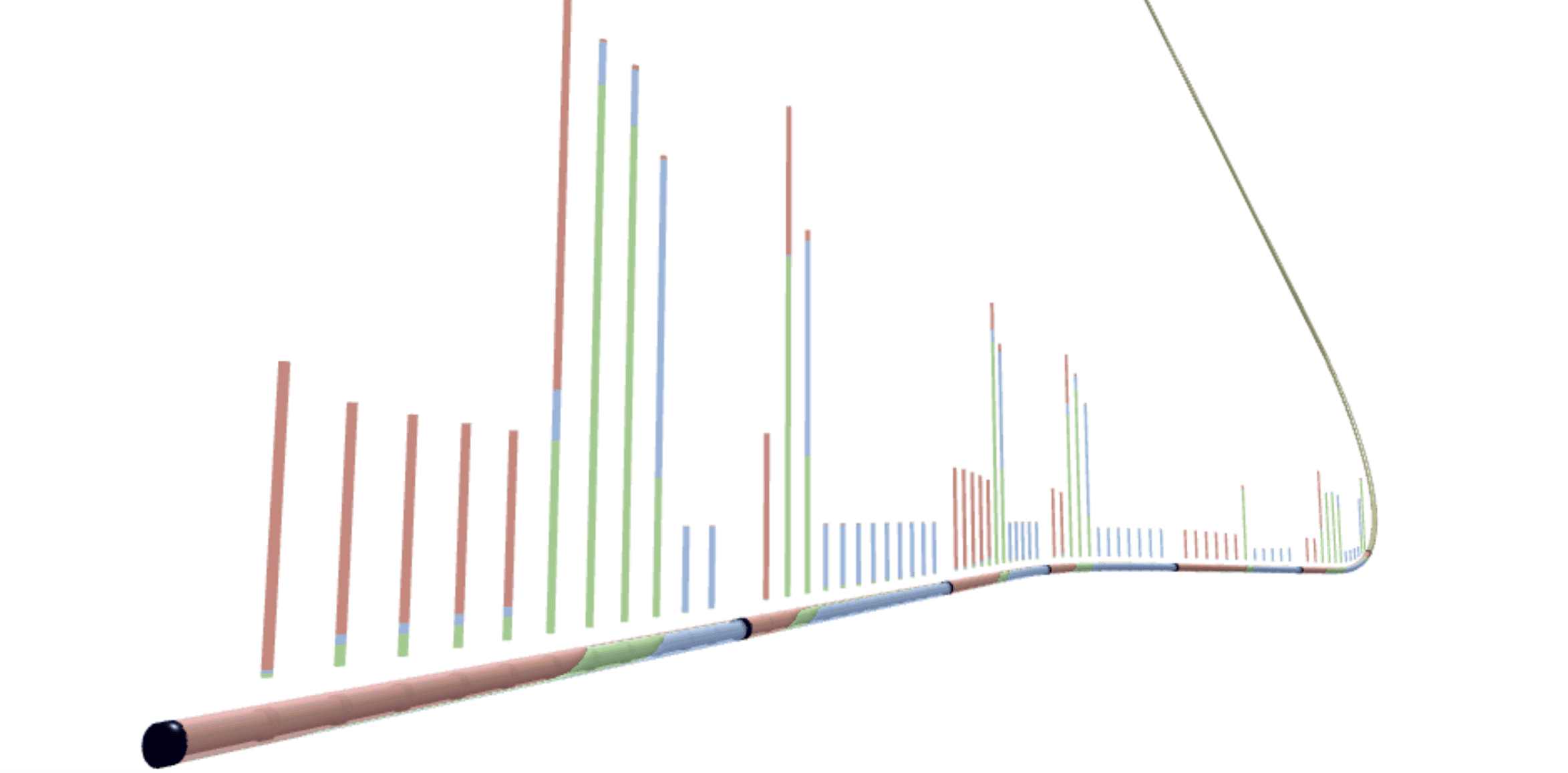
Transient phase segregation
Model the physics that standard reservoir simulators cannot. Insight simulates gravity-driven phase segregation in the annulus, how oil, water, and gas separate between the sand screen and the formation as they flow towards inflow control devices. This is the phenomenon that makes AICD and AICV performance highly sensitive to completion geometry.
- -CFD-based annulus flow simulation with gravity and friction
- -Captures oil-water and gas-liquid stratification between devices
- -Shows how segregation changes with flow rate, inclination, and fluid properties
- -Critical for accurate AICD/AICV completion design
Automatic ICD placement optimisation
Let Insight determine optimal device positions along the wellbore. The optimiser evaluates reservoir heterogeneity, permeability distribution, and well trajectory to recommend ICD/AICD placement that maximises oil recovery and delays water breakthrough.
- -Automatic device spacing based on reservoir properties
- -Optimises for maximum oil recovery or minimum water cut
- -Supports mixed completions, ICD, AICD, AICV, and blank pipe zones
- -Compare optimised vs uniform placement with side-by-side results
Valve type comparison
Compare different inflow control technologies on the same well in a single study. Run the same reservoir conditions and well trajectory with spiral ICDs, nozzle ICDs, FD-AICDs, RCP-AICDs, AICVs, or any combination, and see how each technology performs over the production life of the well.
- -Side-by-side comparison of ICD, AICD, AICV, and ICV technologies
- -Full device library with manufacturer-specific valve characteristics
- -Custom valve curves from CFD data or manufacturer data sheets
- -Decision-ready output for completion technology selection
Built-in VFP generation
Generate VFPPROD tables in place from a trajectory CSV. Pick a multiphase flow correlation, specify your sweep, and feed the resulting 4D table directly into Insight's coupled riser model or export to an Eclipse-compatible .Ecl file. No separate VFP tooling required.
- -Correlations: Flowpro MPF v7, OLGA-S, Beggs & Brill, Xiao
- -Full 4D VFPPROD tables (Qliq × THP × WCT × GLR + ALQ axis)
- -Captures slug-flow and VFP-minimum behaviour at low rates
- -Output direct to Insight or to .Ecl file for external simulators
Production forecasting and multi-period schedules
Generate production profiles that account for inflow control device behaviour, annulus flow dynamics, and reservoir drive. Build multi-period schedules with per-period BHP or rate control and evolving water and gas fractions per zone, configured manually or via staggered-breakthrough generators, to model the well across its full life.
- -Time-stepped production profiles with ICD/AICD effects
- -Multi-period schedules with per-period BHP or rate control
- -Evolving water cut and GOR per zone with staggered-breakthrough generators
- -Cumulative production and recovery factor comparison, exportable for economic evaluation
Device detail to full-well analysis
Start at the smallest scale and build up. Resolve flow at the device level, finer than a single joint, to understand local flow behaviour and device performance. Then scale to the full wellbore, hundreds of joints, multiple completion zones, and full reservoir coupling, using the same physics throughout.
- -Device-level CFD analysis for detailed device characterisation
- -Automatic upscaling from device-level to full-well completion models
- -Consistent physics at every scale, no approximation gaps
- -3,000,000x faster than running full CFD on the entire wellbore
Batch scheduler and case comparison
Run sensitivity studies and design sweeps without babysitting. The Run Scheduler batches multiple .mat cases through the same engine and writes results back automatically. Compare Cases lays the post-processing side by side across the result views, and Save/Load round-trips every input and result so you can pick up where you left off.
- -Run Scheduler for batched .mat cases on the same engine
- -Save/Load round-trips every input and result
- -Compare Cases for side-by-side post-processing across result views
- -Stop button and finished-beep for long unattended batches
IRIS (Integrated Reservoir Inflow Simulator): rapid concept screening
The analytical solver inside Insight. IRIS couples reservoir, completion, and tubing-to-surface in a single fast-solving model, so completion engineers can evaluate dozens of advanced completion concepts in the time it takes to build a single 3D simulation model. Engineers see the true surface deliverability of each concept, not an idealised sand face rate, which is essential when screening completions whose benefits only appear once backpressure, breakthrough, and lift constraints are honoured.
- -Coupled reservoir, completion, and tubing-to-surface model for true surface deliverability
- -Variable k·h description along the wellbore captures along-hole heterogeneity without a full grid
- -Rank passive vs. active inflow control, test nozzle sizing, compare SAS vs. cased-and-perforated vs. frac-pack
- -Bracket the value of additional laterals or longer reach before any grid cell is built
- -Shortens the concept-select loop: only the strongest options carry forward into full 3D simulation
Production tracer simulation (in Insight Ultra)
Coming soonA new tracer analysis module built into Insight Ultra, co-developed with Aker BP. First-principles Fickian release physics from polymer tracer rods, phase-selective release with wetting and dormancy logic, and multiphase transport coupled to the transient annulus segregation model at the core of Ultra. The result is a virtual chemical PLT, a simulated shut-in and restart that produces the same concentration-time response measured at the wellhead, so completion design can be tied back to actual field data.
- -Virtual chemical PLT: simulate shut-in and restart to predict tracer arrival, peak, and decline at the wellhead
- -Zone-by-zone production allocation via history-matching against measured tracer data
- -Phase-selective release for oil, water, and gas tracers with wetting-fraction dynamics
- -Unique coupling to annulus phase segregation, the physics industry-standard simulators cannot resolve
- -Validates AICD and AICV completion design against real production behaviour
Flight, agentic AI orchestration
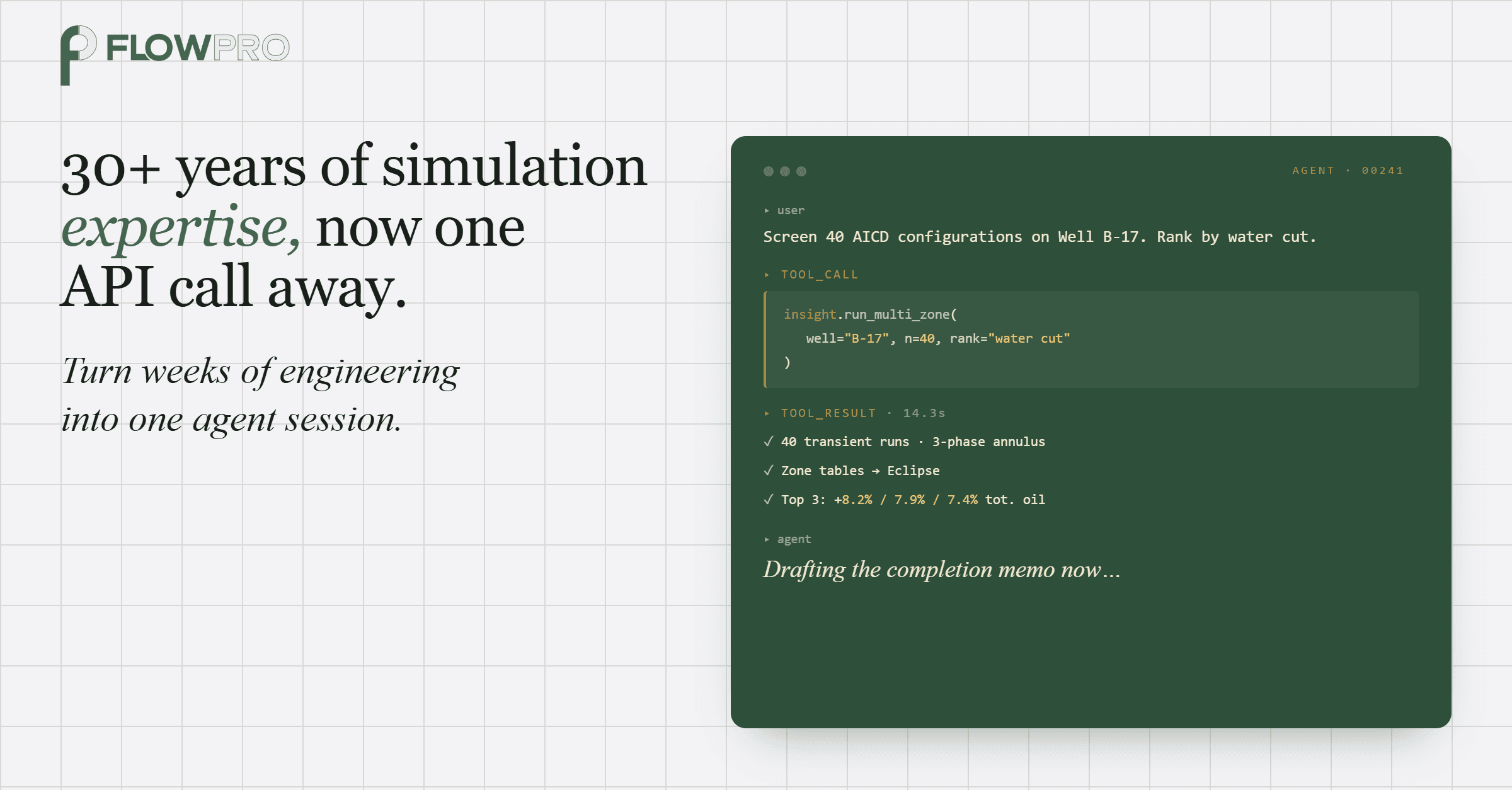
Coming soonFlight is the orchestration layer that lets an AI agent drive Insight. Workflow engine, project management, and an ICT knowledge base sit between the LLM, your reservoir simulator, and the Insight physics core. Vendor library lookups, input handling, run history, and templated workflows are all callable by the agent. Used in-house today to deliver consulting engagements that compress one to two weeks of analyst work into 24 to 48 hours.
- -Workflow and project management module that the agent reasons over and calls
- -Vendor library, inputs, outputs, run history, and templated project setup as agent tools
- -Bridges Insight physics with Eclipse, T-Nav, Intersect, and Reveal in one orchestrated run
- -Works with Claude, ChatGPT, and custom agents driving end-to-end completion design
Performance
3,000,000x faster than standard CFD
Insight achieves CFD-grade accuracy at engineering speed. The upscaling method replaces hours of Ansys Fluent runtime with seconds of computation, validated against commercial CFD on real well geometries.