
Physics engine
From reservoir to surface, with the physics standard simulators miss
Insight is a coupled reservoir-to-surface simulator. Two reservoir solvers, friction-resolved tubing, every major valve type, and a multiphase riser, all solved together. Plus the CFD-grade annulus physics that nothing else captures, validated against Ansys Fluent.
Coupled inflow and outflow
Insight runs reservoir, wellbore, valves, and riser as one coupled system. With Auto-couple enabled, a Picard iteration synchronises inflow (reservoir) with outflow (wellbore + valves + riser) at every schedule period, converging on a self-consistent annulus pressure that satisfies both the depletion physics and the lift physics. Productivity index updates period-to-period from observed drawdown. No manual hand-off between tools.
- -Single coupled solve from reservoir rock to wellhead
- -Picard iteration at every schedule period for self-consistency
- -Productivity index updates dynamically from observed drawdown
- -Multi-period schedules model the full life of the well
Two reservoir solvers, your choice of fidelity
Insight ships with two reservoir solvers, selectable per case. The analytical zonal solver builds an influence matrix in Laplace space and inverts to time, fast enough for batch sweeps and screening, rigorous enough that zones interact correctly through the reservoir. The numerical 3D finite-difference solver uses graded-cell grids and supports stochastic permeability fields for full heterogeneity studies. Same rock, fluid, and completion inputs feed either solver.
- -Analytical zonal solver, fast enough for batch screening sweeps
- -3D finite-difference solver with graded-cell grids
- -Stochastic permeability fields for heterogeneity studies
- -Shared rock, fluid, and completion inputs across both solvers
CFD-based annulus simulation
Insight solves the full Navier-Stokes equations in the annulus between the sand screen and the formation wall. This is the space where fluids from the reservoir mix, separate under gravity, and flow laterally towards inflow control devices. Standard reservoir simulators treat this space as a single node, Insight resolves the detailed 3D flow field.
- -Full 3D computational fluid dynamics in the annular gap
- -Gravity, friction, and inertial forces resolved simultaneously
- -Multi-phase flow with oil, water, and gas interactions
- -Captures recirculation zones and stagnation regions between devices
Phase segregation modelling
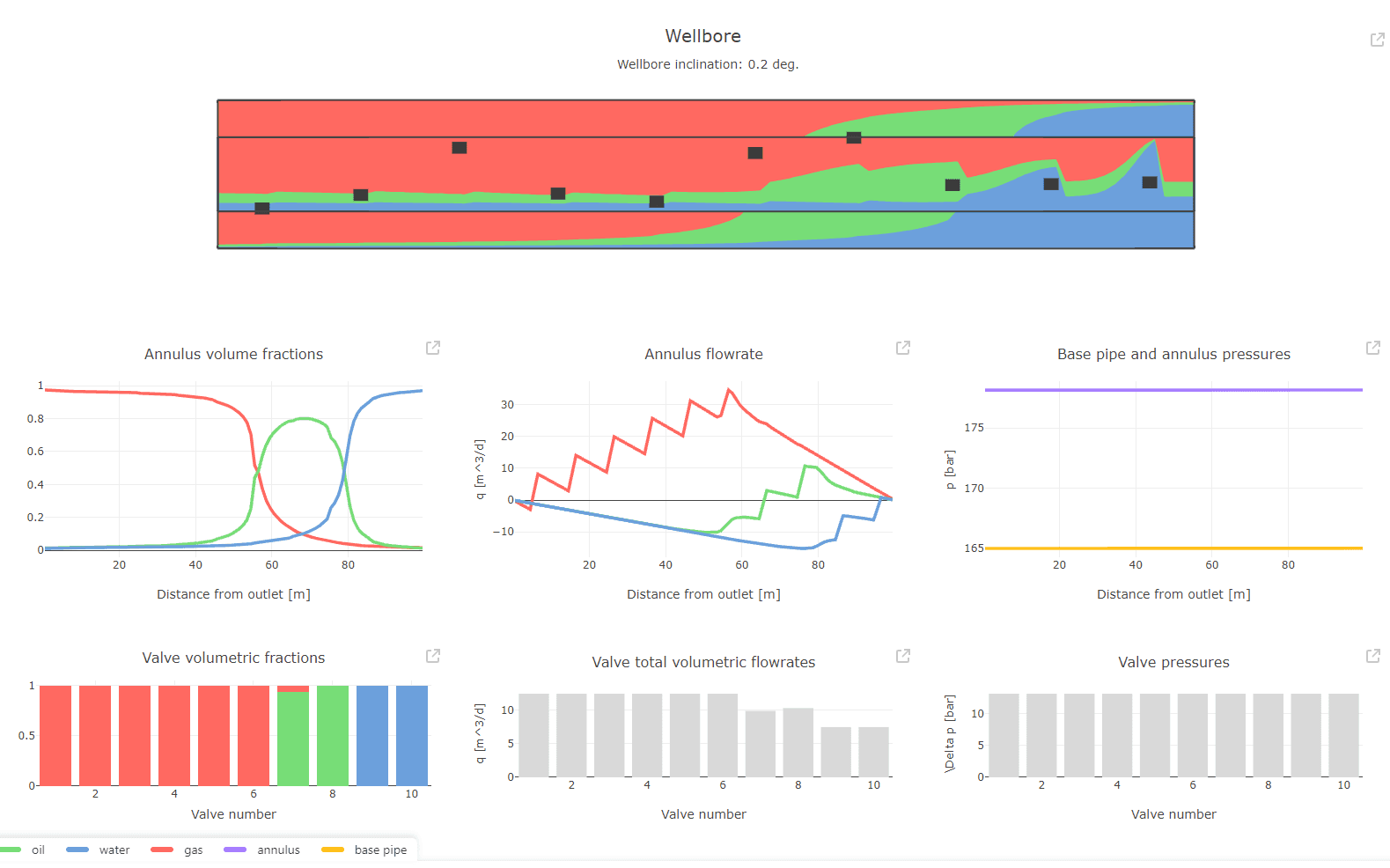
In horizontal and deviated wells, gravity separates oil, water, and gas in the annulus. Water tends to the low side, gas to the high side, and oil distributes between them. This segregation determines which fluid phase reaches each inflow control device, and therefore how the device performs. Insight models this segregation explicitly, accounting for well inclination, flow rate, fluid densities, and completion geometry.
- -Gravity-driven oil-water-gas stratification in the annulus
- -Sensitive to well inclination, even small deviations matter
- -Accounts for fluid properties: density, viscosity, surface tension
- -Shows how segregation pattern changes along the wellbore length
Valve interaction dynamics
Inflow control devices do not operate in isolation. The flow restriction created by one device changes the pressure field in the annulus, which affects the flow arriving at neighbouring devices. Autonomous devices, AICDs and AICVs, respond to the fluid phase they see, which is itself determined by the segregation pattern shaped by upstream devices. Insight captures this coupled behaviour.
- -Device-to-device coupling through the annulus pressure field
- -Autonomous valve response depends on local fluid composition
- -Upstream devices influence downstream segregation patterns
- -Critical for predicting real-world AICD/AICV field performance
Upscaling methodology
Running full CFD on an entire wellbore with hundreds of completion joints would take days of computation. Insight solves this with a rigorous upscaling method: detailed CFD simulations are run at the device level, finer than a single joint, then the results are systematically upscaled to represent the full wellbore in a reservoir simulator. The upscaled model preserves the physics of annulus segregation and valve interaction while running 3,000,000 times faster than equivalent commercial CFD.
- -Device-level CFD captures local flow physics at high resolution
- -Systematic upscaling preserves annulus segregation effects
- -Generates connection factors and valve tables for reservoir simulators
- -3,000,000x computational speedup vs commercial CFD (Ansys Fluent)
CFD-based physics vs legacy mixed-flow simulation
The legacy approach to completion simulation combines steady-state pipe-network wellbore solvers with mixed-flow assumptions at every junction. The annulus is reduced to a one-dimensional pipe and phases are assumed to mix instantly, which collapses the 3D segregated phase field into a bulk average. Every AICD response curve and AICV shut-off threshold is evaluated on the wrong inlet fluid. Studies built on mixed-flow simulation routinely predict water and gas control that the physical completion cannot deliver. Insight replaces the mixing assumption with CFD at the device scale, validated against Ansys Fluent, and preserves that physics all the way through to the reservoir simulator export.
- -Resolves 3D velocity and phase fields in the annulus, not a 1D mixed pipe
- -No complete-mixing assumption at junctions
- -Phase-dependent device response evaluated on real segregated inlet
- -Validated against full commercial CFD, not against other approximations
Validation
Validated against Ansys Fluent
The upscaling methodology in Insight has been independently validated against Ansys Fluent, the industry benchmark for commercial CFD. Results were published in SPE-225617-MS at the SPE Europe Energy Conference in Vienna, June 2025, co-authored with Aker BP and Quickersim.
The validation demonstrates that Insight reproduces the flow physics of annulus phase segregation with accuracy comparable to full-resolution CFD, while running millions of times faster. The paper shows that ignoring these effects can lead to significant production forecast errors for AICD and AICV completions.
Annulus phase segregation and valve interaction cause large simulation errors when unaccounted for. The novel CFD-based modelling workflow in Insight captures these effects and produces results consistent with Ansys Fluent.
By the numbers
Engineering-grade speed, CFD-grade accuracy
3,000,000x
Faster than standard CFD
Compared to equivalent Ansys Fluent simulation
2
Reservoir solvers
Analytical zonal and 3D finite-difference
4
Multiphase correlations
Flowpro MPF v7, OLGA-S, Beggs & Brill, Xiao
30+
Years of ICD research
Continuous development since the 1992 patent
7
SPE/ASME publications
Peer-reviewed papers and one European patent
Learn more
Read the full methodology
The complete technical details are published in SPE-225617-MS and our earlier papers spanning three decades of inflow control research.